From AI Training to Workflow Transformation
Move from AI learning activity to prioritized workflows, Build Sessions, and shipped work.
Sign upPeople programs × AI transformation
I help People teams turn AI experiments into workflows they can use every week. I build the tools and lead the programs that help teams put them to work.
50% to 98% company AI adoption in six months
Featured project
Built with LovableEmpowering People leaders to run equitable talent calibrations grounded in observable evidence, transparent rationales, and intentional talent design.
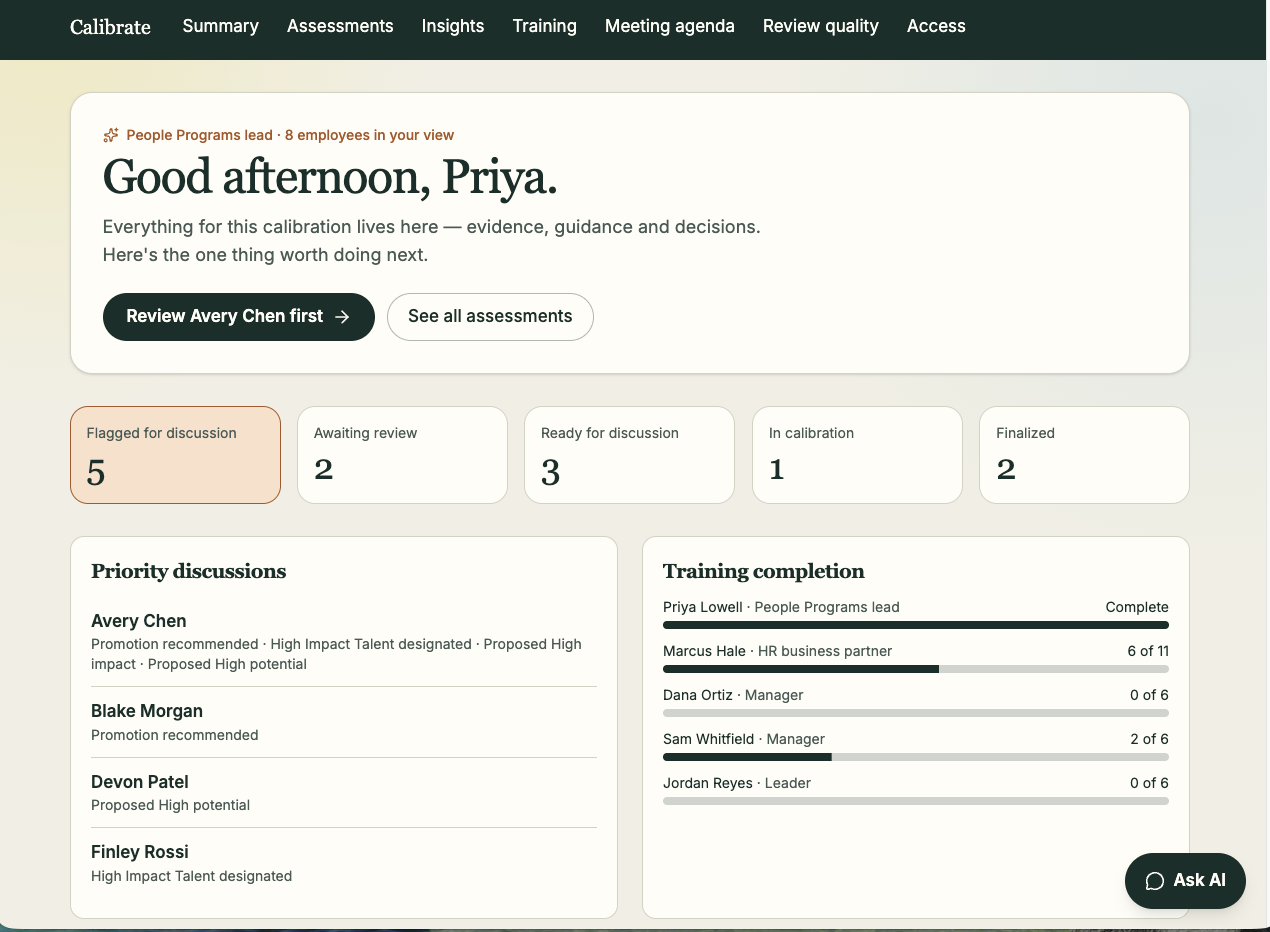 View full screenshot ↗
Live and recorded
Practical Maven sessions for People leaders moving from AI adoption to workflow transformation.
Move from AI learning activity to prioritized workflows, Build Sessions, and shipped work.
Sign upHelp managers choose meaningful team tasks, build AI practice through paired experiments and peer sharing, and measure whether changes improve work.
Sign upExperience
Filter the portfolio, then open a case study for a concise view of the challenge, approach, outcome, and what I learned.
Filter examples
A connected system of Champions, manager enablement, fluency assessment, structured practice, and peer sharing.
Adoption grew from 50% to 98% in six months.
Decentralized expertise through clear roles, peer learning, community rituals, and practical support.
Champion outreach drove 52% AI Survey participation.
Shifted learning toward application, demos, and visible examples of how AI changed work.
Every measured category improved over four months.
A rubric, custom learning plans, usage signals, and a manager-ready dashboard for tracking fluency, time saved, blockers, and coaching needs.
ADKAR workshop, Manager 101 session, 1:1 toolkit, and peer sharing to make AI part of team leadership.
Empowering People leaders to run equitable talent calibrations grounded in observable evidence, transparent rationales, and intentional talent design.
AI-generated HRBP prep · Ask AI chat
I built this prototype with Lovable. It generates preparation material for HR business partners ahead of calibration meetings and includes an in-app Ask AI chat for questions during the workflow.
View full screenshot ↗
Company-accessible AI support designed to make a high-friction People process easier to navigate.
1k total messages · 181 conversations
Prioritized opportunities using frequency, reusability, complexity, and strategic alignment.
An AI-enabled operating system for employee listening, HRBP planning, and People team execution.
Designed an AI-enabled operating system that automates employee listening, HRBP planning, 1:1 preparation, meeting follow-through, internal communications, OKRs and executive reporting.
Autonomous coordination for monthly cross-functional learning, cutting manual chase-down work to zero.
Built an autonomous coordination agent for a monthly cross-functional learning session. It synthesizes signals from Slack, Gmail, meeting notes, and external AI news into named, attributable content proposals, self-triggers reminders on a rolling deadline calendar, and updates the presentation deck, cutting manual chase-down work to zero.
No examples match this filter yet.
Practical tools and guides for People leaders moving from AI adoption to meaningful workflow transformation.
Assess your organization across Access, Ability, Application, and Amplification. Identify your primary bottleneck and build a practical 30-day action plan.
Get the Free DiagnosticAnswer eight questions, see your scores across four dimensions, and get a practical 30-day plan. No email required.
Start the assessmentCopy this prompt into your AI assistant to quickly assess where your organization is today and identify the best next step.
Help me assess my organization’s AI fluency using these four dimensions:

Access
Can employees safely access and use approved AI tools with clear guardrails?

Ability
Can employees use AI effectively and independently in their roles?

Application
Are employees using AI to improve or redesign meaningful, recurring workflows?

Amplification
Are successful AI workflows and practices spreading across teams?

Start by asking me 6 questions, one at a time. If I say ‘quick diagnostic,’ ask all six questions at once so I can answer them in a single response about:

- AI access and guardrails
- Adoption and usage
- Employee capability
- How AI is being applied to real work
- How successful practices are shared
- How we measure AI impact

When assessing adoption and usage:

- Ask me to reference any available analytics from the AI assistant or platform we use, such as active users, frequency of use, repeat usage, or usage trends.
- Ask whether adoption differs meaningfully by team, function, role, geography, or other employee group.
- Do not rely only on an organization-wide average if more detailed data is available.
- If adoption varies significantly across groups, reflect those differences in the diagnosis and recommendations.
- Do not assume high usage means high AI fluency.

After I answer, give me:

1. A 1–5 score for Access, Ability, Application, and Amplification
2. My organization’s primary AI fluency gap
3. Any important differences in maturity across teams or functions
4. The most important strategy to prioritize next
5. Three actions we could take in the next 30 days
6. Three measures we should track
7. One thing we should not prioritize yet

Use this guidance when recommending next steps:

- Low Access → focus on tools, governance, trust, and guardrails
- Low Ability → focus on role-specific learning, managers, and peer support
- Low Application → focus on workflow discovery and redesign
- Low Amplification → focus on Champions, reusable assets, sharing, and scaling

If different teams are at different maturity levels, recommend different interventions where appropriate instead of forcing one organization-wide solution.

Finish with:

Our AI Fluency Priority:
[one sentence]

Our Next Move:
[one action]

And complete this statement:

“Our organization does not primarily need more AI ________. We need ________.”
Diagnose your network, select trusted Champions, agree on support, and plan a small pilot that builds independent AI capability. Includes editable worksheets and an AI planning prompt.
Get the Free Starter KitDesign or improve a small Champions network with an evidence-based diagnostic, role agreement, and four-week workflow pilot. Say “quick plan” to answer all six questions together.
You are my AI Champions Network Planning Partner. Help me design or improve a small network that spreads capability beyond the Champions themselves.

Use only the evidence I provide. Do not invent candidates, approvals, capacity, adoption levels or results. Mark unknowns and label suggested targets as proposals. Ask me to use role labels and non-sensitive workflow summaries.

Start by asking these six questions one at a time. If I say “quick plan,” ask all six together:

1. Are we starting or improving a network? Which team and business problem should the pilot focus on?
2. What approved AI tools and data-use boundaries exist? Who resolves tool, data or risk questions?
3. How does AI expertise currently spread? What evidence shows reuse and independent practice? Reference available platform analytics for usage, but do not equate usage with capability.
4. Who could be a Champion? Consider peer trust, curiosity, workflow knowledge, coaching behavior and representation across relevant employee groups. What evidence supports each candidate?
5. What manager support, protected time and central enablement support can we realistically agree on?
6. Which recurring workflow could we test, what is the current baseline, and what would useful, accurate output and independent use look like?

Then draft content for two editable working pages:

PAGE 1: DIAGNOSE AND SELECT

Assess Coverage, Authority, Community, Reuse and Transfer. Use 1 = absent, 3 = inconsistent and 5 = reliable across teams only when evidence supports a score. Leave unknowns unscored. Identify the primary gap.

Compare candidates using Credibility, Curiosity, Context and Catalyst, noting representation gaps. For a new network, identify design priorities rather than assuming maturity.

PAGE 2: AGREE AND PILOT

Draft a Champion role agreement covering responsibilities, manager support, protected time, decision boundaries, escalation contacts and recognition. Champions coach peers; designated owners approve tools and risk.

Build a four-week plan for one team and one workflow using Show, Solve, Share and Transfer. Include owners, a manageable cadence and reusable documentation: inputs, steps, guardrails, quality checks, owner and example.

Set an end-of-pilot review using quality, actual reuse and independent use. Treat time savings as unverified unless measured.

Keep the plan achievable within the stated capacity. Flag approval dependencies and separate confirmed facts from proposals. End with one action I can take this week.

Wait for my answers before drafting the plan.
“Learning AI can feel overwhelming, but Stephanie made it approachable. I’d been trying to build a manager change workflow and kept getting stuck. Stephanie was patient, took the time to understand my goals, and helped me see different ways to set it up that I hadn’t considered. I came away with a workflow I actually use and much more confidence using AI in my work.”
Free AI + Workflow Consultation
Have a People or HR workflow that feels more manual than it should be?
Request a Free Consultation“I came away with a workflow I actually use and much more confidence using AI in my work.”